

A BUSINESS COURSE FOR WEDDING STATIONERS
The design half is the part you love.
This is the prosper half.
Seven modules on the systems underneath a stationery studio — pricing, inquiries, consultations, proofs, production, and the quiet structure that keeps all of it from running you.
OPENS OCTOBER 1 • $397 FOUNDING PRICE
WHY THIS EXISTS
Nobody struggles with the paper.
They struggle with everything around it.
There is no shortage of instruction on how to design a suite. Layout, typography, ink, stock; that education is everywhere, and most stationers are already good at it.
What isn't taught is the rest of it. What to charge and how to explain it without flinching. What to do with an inquiry that arrives with no budget and no date. How to run a consultation that ends in a decision. How many proof rounds to give, and what happens on the fourth. Which clients to turn down.
Those are the parts that decide whether a studio holds together. They are also the parts most of us learned the expensive way.
WHO IS THIS FOR
Written for a working stationer.
Not for someone deciding whether to be one.
This will fit if
You are taking client work and want the business side to feel as considered as the design.
Your pricing was set by instinct and you have never rebuilt it from the numbers up.
Inquiries come in and go quiet, and you are not sure where they fall off.
Every project runs a little differently because the process lives in your head.
You want to raise your prices and need language you can actually say out loud.
This will not fit if
You are looking for design instruction, templates to sell, or a style to borrow.
You want a scalable, hands-off, passive-income version of a stationery business.
You are hoping for a script that closes every couple. There isn't one.
You would rather have a formula than a system you adapt to your own studio.
WHAT’S INSIDE
Seven modules.
Released together, on the first day.
No drip schedule. You get all of it at once and work through it at whatever pace your calendar allows.
I. Positioning Your Studio
Deciding what you do and, more usefully, what you don't. Where the line falls between your tiers, and why narrowing tends to raise the caliber of what comes in.
II. Pricing Luxury Stationery
Building a price from materials, method, and design time rather than from what feels reasonable. What each print method actually costs per piece, and how to talk about money without apologizing for it.
III. The Inquiry Pipeline
What happens between the form submission and the signed contract. Sorting inquiries into the right tier, running a consultation that ends somewhere, and writing a proposal that invites a decision.
IV. The Client Experience
Proof rounds and where they go wrong. Why a couple stops seeing errors after the second look. The check that catches the mistakes no one else will, and what to do when a client disappears mid-project.
V. Contracts & Boundaries
The terms that protect the work and the relationship at the same time — timelines, approvals, revisions, and what happens when something slips.
VI. Production & Fulfillment
Moving an approved suite through print, assembly, and mailing without losing the margin you priced for.
VII. The Studio Year
Running a seasonal business on purpose — booking capacity, slow months, and knowing what a full year should look like before it starts.
WHAT COMES WITH IT
The tools, not just the talking.
Everything is your to keep.
The Suite Pricing Calculator
A working spreadsheet with live formulas. Enter your materials, quantity, and print method; see the price, the margin, and what a change to any one input does to the rest.
Templates & Scripts
The written pieces you can adapt and use the same week — inquiry replies, consultation structure, proposal sections, proof-round language, and the money conversation.
The Toolkit
Every platform, vendor, and supplier the studio actually runs on, with what each one is for and where the discounts are. Including the things I've tried and stopped using.
WHO IS TEACHING IT
I’m Ashley.
I have made most of these mistakes personally.
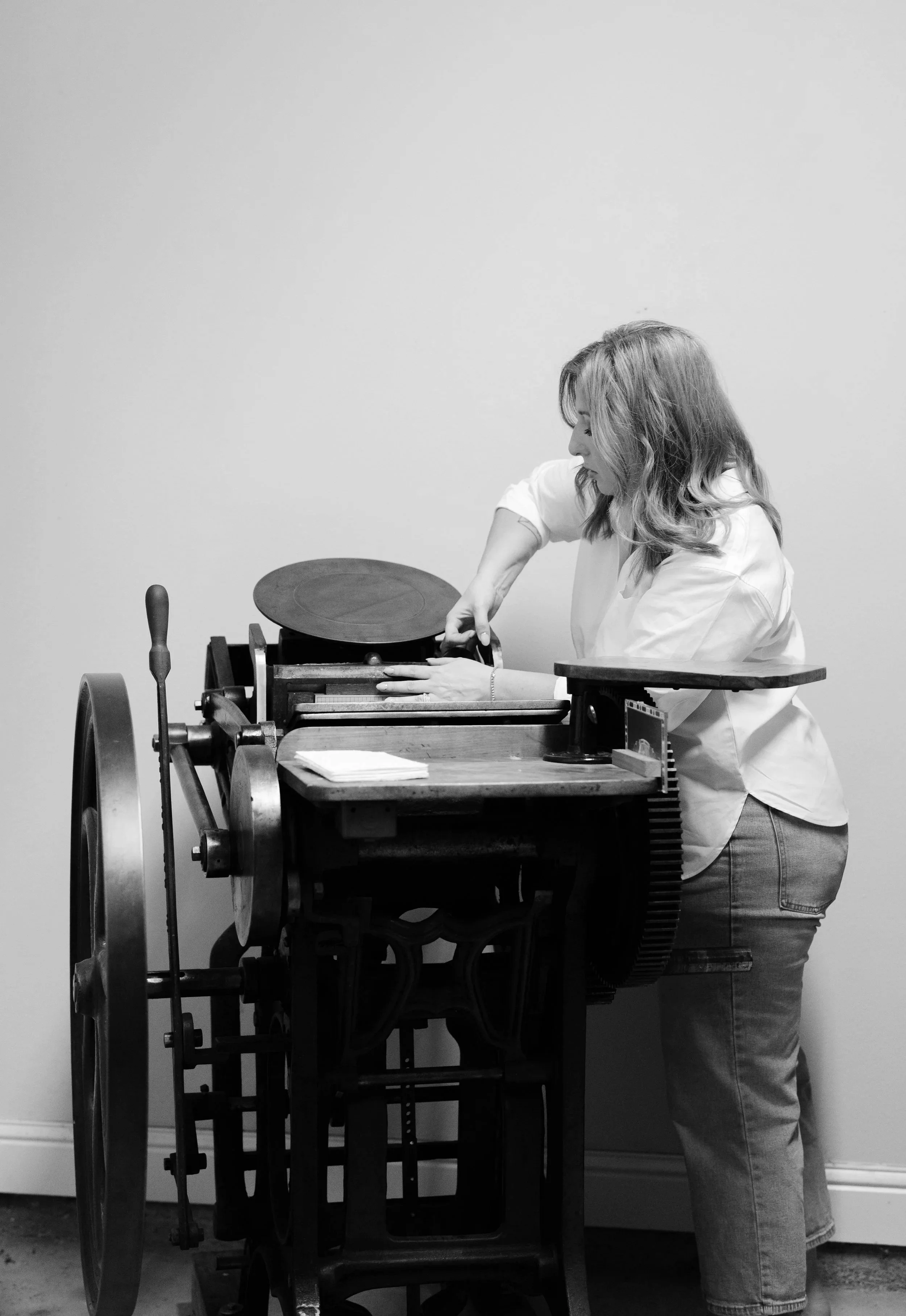
I started InvitoBella in 2011 and have spent fifteen years running a stationery studio, most of that working alongside trade printers, and the last two with letterpress in-house, on three presses my husband Jason and I know by name.
The design side came naturally. The business side did not. I priced too low for years, said yes to projects I should have declined, and rebuilt my inquiry process three times before it stopped leaking. Everything in this course is a system I use now, in a studio that is still running, with the reasoning behind it.
You will not see my client work here, and that is deliberate. None of this depends on my aesthetic. It works whether your studio looks like mine or nothing like it.
ENROLLMENT
The founding group.
Opens October 1.
$397
RISES TO $497 AFTER LAUNCH
All seven modules, released at one.
The Suite Pricing Calculator
Every template, script, and worksheet
The Toolkit, with vendor discounts
Lifetime access, including updates.
-
No. There is no Illustrator instruction, no design theory, and no aesthetic to adopt. This is the business underneath the design work.
-
No. Most of my own fifteen years were spent working with trade printers, and the pricing, inquiry, and client systems here are written to work either way.
-
Plan for a few hours per module if you are doing the work alongside it, not just watching. Nothing is timed and nothing expires.
-
Mostly voiceover over the material we're working through, so you can see the actual numbers, templates, and language rather than watching me talk.
-
You will get more from this with a few real clients behind you. If you haven't taken paid work yet, the pricing and positioning modules will still be useful, but much of the rest will feel theoretical.
-
No, everything unlocks the moment you enroll, so there is nothing to return. What I would rather do is help you feel certain before you spend the money. If you are weighing it and want a straight answer about whether it fits your studio, email me. I am glad to tell you honestly, even if the answer is that you should wait.
BEFORE YOU DECIDE